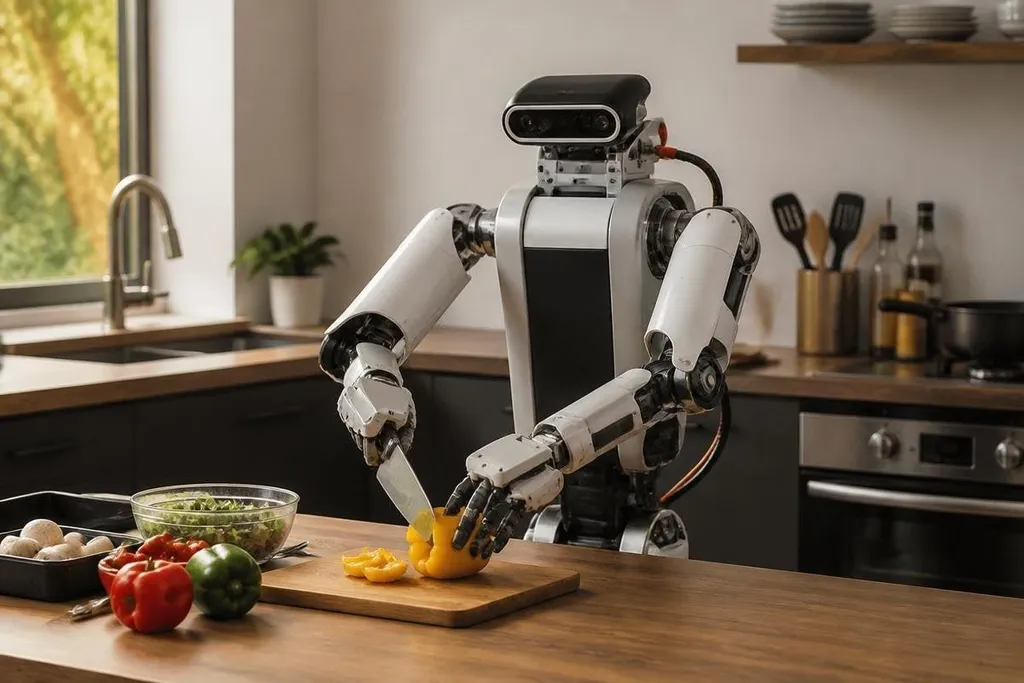
A robot that makes one meal from raw ingredients must handle food, tools, heat, timing, and cleanup in the same kitchen. No public evidence sets a reliable date for that level of home cooking, so the useful answer is to watch the tasks, not the demos.
- One task is close: fixed stations can support repeatable jobs such as moving or stirring food.
- A full meal adds timing: several dishes must finish in the right order and stay safe to eat.
- The hard part is the kitchen: loose food, changing shapes, spills, heat, and crowded worktops confuse robots.
A complete meal is a chain of small jobs
Cooking a meal means more than moving a pan. The robot has to identify ingredients, open packaging, measure portions, cut or place food, control heat, check progress, serve the result, and clean the work area.
Each job changes the next one. A wet ingredient can slip from a gripper, a cut piece can vary in size, and a pan can become too hot before the robot reaches the next step.
A person adjusts without stopping to plan every correction. Sensors and software must handle each change for the robot.
That makes a recipe a long chain of actions. A failure near the start can affect the whole meal, even if the robot performs the later steps correctly.
Heat and food make the problem harder
Factory robots work well when their parts, positions, and surroundings stay fixed. A kitchen does the opposite. Ingredients arrive in different shapes, tools move between drawers, and surfaces collect water, oil, flour, and scraps.
Heat adds another limit. The robot must hold a hot pan without damaging its gripper, read cooking progress from more than a timer, and keep hands, cables, and sensors away from unsafe surfaces.
It also needs a safe response when food burns or a pan shifts.
Food handling needs care for a different reason. A robot may need to tell raw food from cooked food, keep tools separate, and recover after a spill. Those are practical safety tasks, not features a short video can prove.
Why recipe demos don't answer the date
A short demo can show a robot completing one recipe in a prepared kitchen. It may still leave out ingredient setup, failed grasps, camera cuts, cleaning, and the time needed to reset the station.
The useful test is repeated work under normal conditions. Can the robot make the same meal after an ingredient moves? Can it handle a soft vegetable, a sticky sauce, or a container with a different lid? Can it stop safely when a person reaches into the work area?
A plated meal at the end of a demo says little about the work behind it. Robotics reporting from Robot24.com can show the recipe, tools, timing, and human help recorded during a test, so you can compare that demo with work in a home kitchen.
One system may do well in a kitchen built around its own reach, tools, and software. That still differs from a robot that enters an ordinary home and works with the equipment already there.
A better way to judge progress
For someone deciding whether to wait for a cooking robot, these checks matter more than a promised release window:
- Recipe range: Check whether the system repeats one dish or handles meals with different textures, tools, and cooking times.
- Kitchen setup: Ask what must be moved, marked, replaced, or kept within a fixed reach.
- Human recovery: Look for clear steps when a lid sticks, food spills, or a person interrupts the task.
- Food safety: Check how the robot separates raw and cooked ingredients and confirms safe cooking conditions.
- Full timing: Find out whether the claim includes preparation, cooking, serving, and cleanup.
- Proof quality: Look for repeated runs, full video, failure records, and an explanation of what the robot could not do.
The likely path to complete meals
The first useful systems will probably handle a narrow set of meals in a controlled kitchen. That could mean fixed ingredient locations, marked work areas, special cookware, or a person who prepares the harder steps.
Broader home cooking needs progress in several places at once: better grasping, safer contact with hot objects, stronger scene understanding, and software that can recover from small errors. Doing one of those jobs well still leaves the rest of the chain.
I'd wait for evidence of repeated full-meal runs before treating home cooking as solved. The date that matters is not when a robot cooks one meal, but when it can prepare, serve, and clean up after many ordinary meals without a person standing beside it.